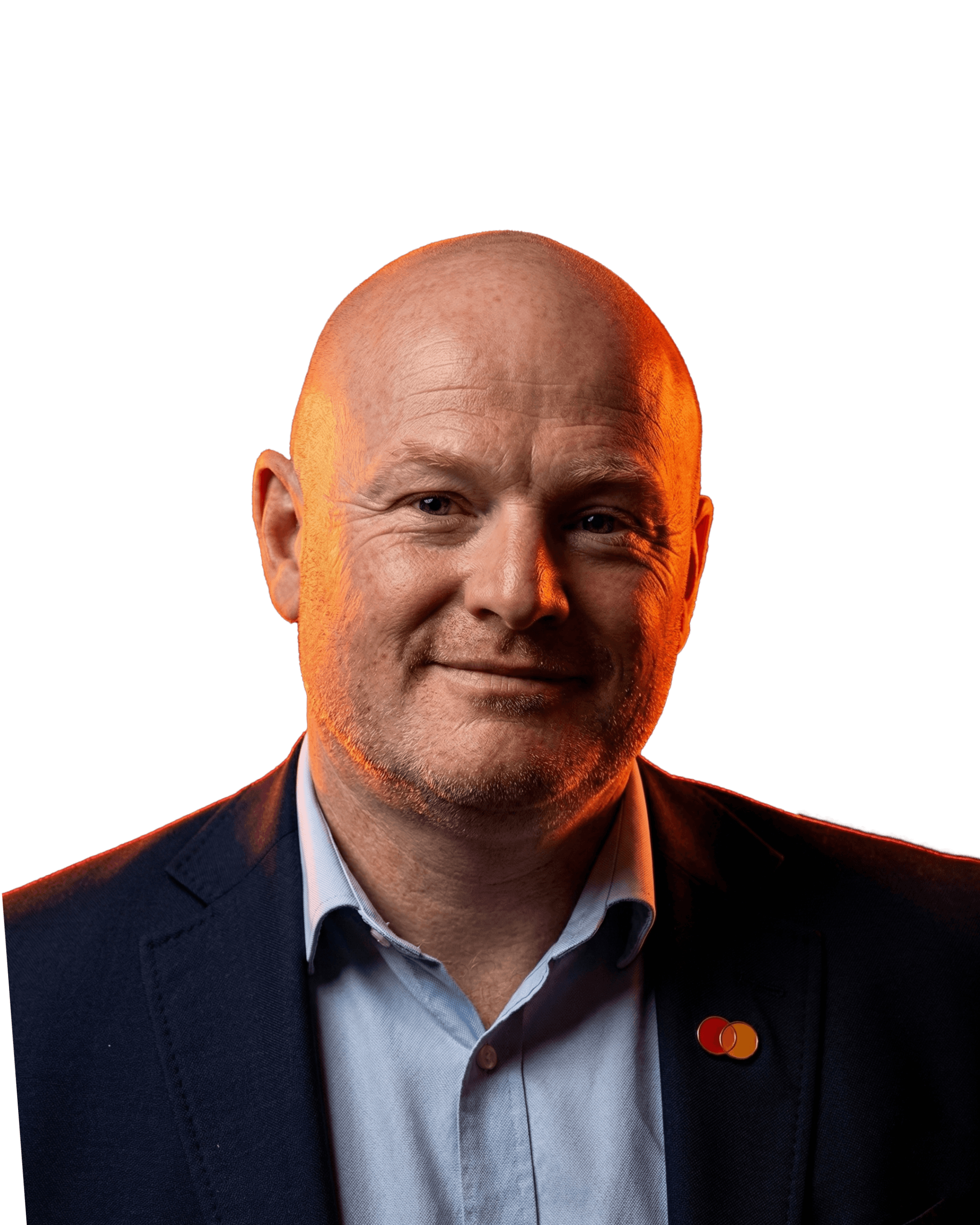
Ken Moore
CIO, Mastercard
Chief Innovation Officer of Mastercard, running the Foundry organisation that scans emerging technology and takes risk out of new products before the business scales them, and arguing that agentic commerce is held back by trust rather than by technology.
Why the room needs them.
Ken Moore leads Mastercard Foundry, which he has described as scanning roughly 20 emerging technologies on a six to seven year horizon. By his account, the innovation organisation holds new products until risk has been taken out of them. At Proof of Talk Paris 2026 he took the agentic commerce question on the main stage, in a fireside on stablecoins and the payment rails an agent-driven economy would need. His position, set out at Mastercard's Innovation Forum weeks earlier, is that the technology already exists and the harder problem is engineering trust into the ecosystem.
The full account.
Ken Moore is Chief Innovation Officer of Mastercard and leads Foundry, the company's innovation organisation. He spoke at Proof of Talk Paris 2026 in a day one fireside on the Hecto Main Stage, at 10:30, titled "Beyond Stablecoins: Mastercard and the Future Rails of Agentic Commerce", alongside Christine Lee.
He joined Mastercard in 2016 as executive vice president, Mastercard Labs, and Mastercard was describing him as its chief innovation officer by February 2021. Its executive bio sets out Foundry as bringing together research and development, Digital Futures, Product Lifecycle Management, and Experience Research and Design; credits him with scaling the startup engagement programme Start Path in the Labs role; and lists him as an Expert-in-Residence at Harvard Innovation Labs and an advisory board member to the World Intellectual Property Organization on the Global Innovation Index. Mastercard's investor relations site places him on the company's management committee. When Mastercard opened its European Technology Hub in Dublin in April 2022, it described the One South County campus as the headquarters of its global research and development division, Foundry, and quoted him in the announcement. Before Mastercard he held roles at Citi, Accenture and Misys. He holds a BSc in Commercial Computer Applications from the Institute of Technology in Waterford, and is a certified Board Director with the Institute of Directors.
Asked in a March 2023 interview to define the job, he broke it into four parts: building what he calls growth operating systems, the skills and ways of working Mastercard organises into job families it calls guilds; informing strategy by scanning roughly 20 emerging technologies on a six to seven year horizon; taking risk out of new products against client-market fit, solution uncertainty and commercial uncertainty before the product groups scale them; and differentiating the company with clients, partly through experience centres that host about 8,000 of them a year. Foundry, he said, is a service to the rest of the company rather than a revenue or a cost centre, and fails a very large number of initiatives every year by design.
At the inaugural Mastercard Innovation Forum in Canada in April 2026 he led a conversation on agentic commerce and called trust "the currency of innovation", the framing Mastercard had used around its 2022 Business Innovators Index with Harvard Business Review Analytic Services.
What Ken believes about the next ten years.
Years of shipping.
Lines that keep proving correct.
“The technologies exist today. Really, the challenge is more about engineering trust into the ecosystem.”
“[When] you give permission to an agent to act on your behalf, you're actually creating a new threat surface, a new threat vector. But we should also understand that in that threat, there are also opportunities.”
“Innovation needs to be embedded in your culture, and it can't just be in a soft way. I think you have to measure it at some level, because what you don't measure, you don't care about.”
What they have built, written, and backed.
Built
- Mastercard FoundryThe innovation organisation he leads. Mastercard's executive bio sets it out as research and development, Digital Futures, Product Lifecycle Management, and Experience Research and Design. In April 2022, opening its European Technology Hub on the One South County campus in Dublin, Mastercard described that building as the headquarters of Foundry, its global research and development division; the company employed 975 people in Dublin at the opening.
- A three-test gate before anything scalesAs he described it in March 2023, Foundry holds a new product until risk has been taken out against client-market fit, solution uncertainty and commercial uncertainty, then transitions it to a product group to scale globally. The unit is structured as a service to the rest of Mastercard rather than as a revenue or a cost centre, and fails a very large number of initiatives every year by design: "We are designed to tolerate that failure, perhaps in a way that a product group isn't."
- Growth operating systems and guildsThe first of the four parts he gives his own remit: the skills, tools and ways of working of Mastercard's people, organised into job families the company calls guilds. He argues the culture side has to be measured and written into job descriptions and annual performance assessments rather than left soft.
- Horizon scanning and the client experience centresA standing scan of roughly 20 emerging technologies out to about a six or seven year horizon, used to inform company strategy alongside work anticipating shifts in end-customer behaviour, paired with a network of physical client experience centres that he said in 2023 host about 8,000 clients a year.
The next Proof of Talk is in Abu Dhabi.
Louvre Abu Dhabi, 3–4 December 2026. Admission is by application, and the room is capped at 2,000.
Request access